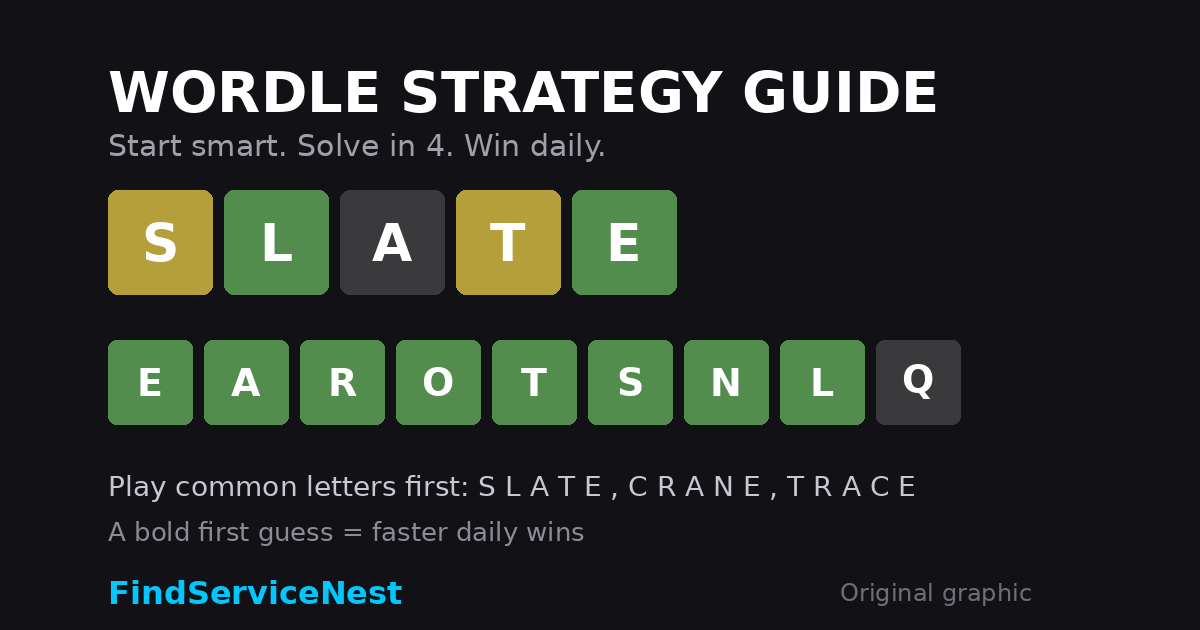
Wordle gives you six guesses to find a five-letter word. The fastest way to win is straightforward: open with a word packed with common letters — SLATE, CRANE, or TRACE — use the color feedback to eliminate possibilities, then stop exploring and start solving by guess four. This guide covers every tactic that actually works, plus the 2026 rule change that reshaped how the daily puzzle behaves.
How Does Wordle Actually Work?
Wordle is the daily five-letter word game from The New York Times, created by software engineer Josh Wardle in 2021 and acquired by the NYT in early 2022. Everyone on Earth gets the same word each day, and a new puzzle unlocks at midnight your local time. With more than 3 million people playing daily, streaks and shareable emoji grids have become part of the culture.
After each guess, tiles change color:
- Green — the letter is correct and in the right position.
- Yellow — the letter is in the word, but in a different position.
- Gray — that occurrence is not in the word. (Careful: another green or yellow copy can mean the letter still appears elsewhere.)
Your guesses must be real five-letter words. According to official NYT data, most successful players find the answer in four guesses — which the community calls “par.” Your goal is to beat par.
What Is the Best Wordle Starting Word?
Your first guess is pure information-gathering. A strong opener tests as many common letters as possible: the frequent consonants S, T, R, N, L and the common vowels A, E. Proven data-backed starters include:
- SLATE, CRANE, TRACE, CRATE — balanced openers; each combines three common consonants with two of the most common vowels.
- RAISE, STARE — favorites among mathematically minded players for common-letter placement.
- ADIEU, AUDIO — vowel-heavy openers if you want to lock the vowels down first. They are weaker on consonants, so follow them with a consonant-heavy second guess.
Stick with the same starter every day. A consistent opener builds a mental model of how to read the feedback it produces, so you react faster on guesses two and three.
Should You Use a Two-Word Opening?
Advanced players often spend their first two guesses testing ten different letters. Pairs like CRANE + STOMP or SLATE + CORNY cover the ten most common letters with zero overlap. If your first guess returns mostly gray tiles, a complementary word that avoids every tested letter — something like CLOUT or NYMPH — hunts down the remaining vowels and consonants.
The trade-off: you burn two guesses before knowing anything. Use a two-word opening when your first result is weak (zero to one colored tile). When your opener already lights up two or three letters, skip the second exploratory word and start building toward the answer.
How Do You Handle the Middle Guesses?
Guesses two through four are where games are won. Rules that actually lower your average:
- Never replay a ruled-out letter. Gray means done — unless a duplicate copy showed green or yellow, in which case test the repeat deliberately.
- Watch for double letters. Answers like GEESE hide two E’s; yellow and green counts can mislead you until you test the repeat on purpose.
- From guess four on, stop discovering and start locking. Arrange the letters you already know into real words instead of probing new ones.
- Stuck? Fill the missing vowel. List your green and yellow letters, then work through the vowel you have not seen yet — it is usually the gap.
What Changed About Wordle in 2026?
The biggest shake-up in Wordle history arrived in February 2026. For years, once a word was used as an answer it was retired forever. The NYT reversed that policy: previously used answers are now back in rotation, starting with CIGAR — the very first Wordle word — on February 2, 2026. You can no longer assume a word is not the answer just because you have seen it before.
The NYT also integrated a Wordle archive for Games subscribers, offering more than 1,000 past puzzles, and launched WordleBot analytics to review your play. Practically, this means two things: keep your strategy tight instead of gaming the answer list, and use the archive to practice without burning your daily streak.
How Do Hard Mode and the Wordle Archive Work?
Hard mode (an optional setting) forces you to reuse every revealed letter: any green or yellow tile must appear in all of your later guesses. That rules out throwaway discovery words, so your opener and follow-ups have to be flexible — words like SALET and TRACE stay strong in hard mode.
The archive, available to eligible NYT Games subscribers, lets you replay over 1,000 past puzzles. It is the best way to train without risk: practice your two-word openings, learn how often double letters appear, and study which guesses the WordleBot flags as wasted. Pair archive practice with a consistent daily starter, and your average will drop within weeks.
Want to put this into practice right now? Play our free Wordle game to test your new opening word, then challenge yourself with more of our free puzzle games.
Frequently Asked Questions
How many guesses do you get in Wordle? Six. You have six attempts to identify the hidden five-letter word, with color feedback after every guess to guide you.
Is Wordle free? Yes. The daily puzzle is free on the NYT website and the NYT Games app — no subscription required. The archive of past puzzles is for Games subscribers.
Does Wordle repeat words? It does now. Since February 2026, the NYT has been reusing previous answers, starting with CIGAR on February 2, 2026. A past answer can come back on any day.
What does hard mode do in Wordle? Hard mode forces you to reuse every letter you have revealed: any green or yellow tile must appear in all following guesses, which removes exploratory “throwaway” words from your strategy.
Leave a Reply