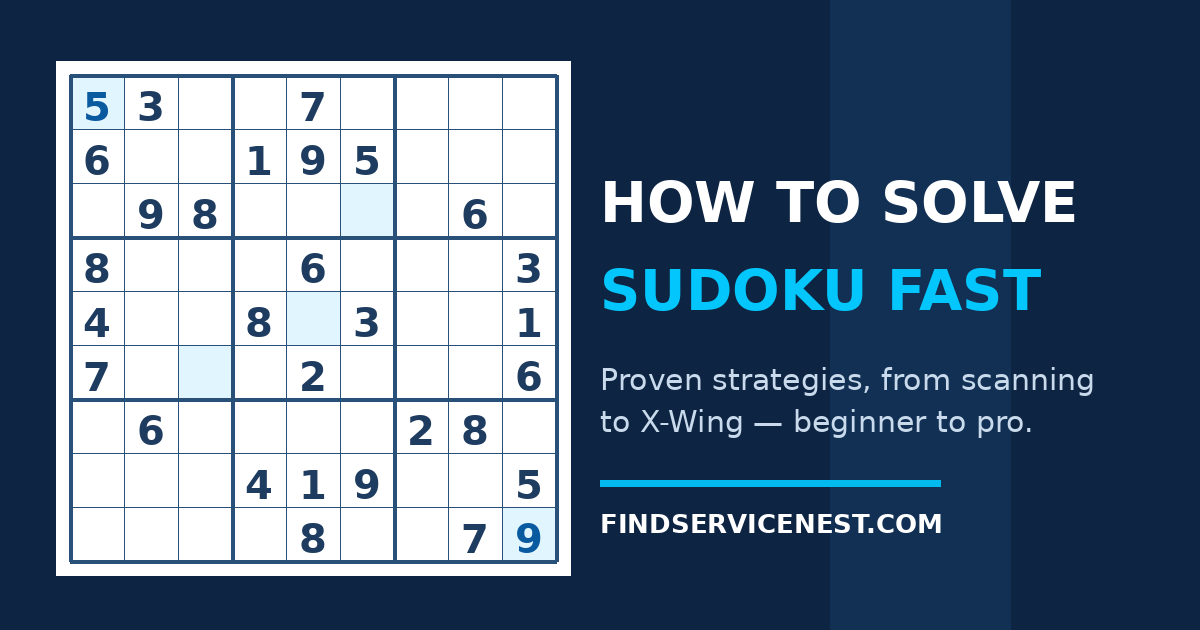
The fastest way to solve Sudoku is to work in layers: scan rows, columns, and 3×3 boxes for forced placements, track candidates with pencil marks, then apply patterns like naked pairs and X-Wing for hard puzzles. Easy and medium puzzles rarely need advanced techniques — clean scanning plus disciplined candidate tracking solves them.
What Are the Rules of Sudoku?
A standard Sudoku is a 9×9 grid divided into nine rows, nine columns, and nine 3×3 boxes. Every row, column, and box must contain the digits 1 through 9 exactly once — no repeats, no missing numbers. A proper puzzle has exactly one solution, and mathematicians have proven that a valid puzzle needs at least 17 starting clues (givens); no 16-clue puzzle can have a unique solution.
That constraint is part of what makes Sudoku endlessly replayable: there are 6,670,903,752,021,072,936,960 possible completed grids. You will never run out of fresh puzzles.
What Is the Best Way to Start a Sudoku Puzzle?
Start with scanning — the fastest technique and the only one most easy puzzles require. Pick a digit, say 5, and look at each 3×3 box: using the 5s already placed in nearby rows and columns, find boxes where only one cell can hold a 5. Work through all nine digits this way, then repeat.
Two scanning habits separate fast solvers from slow ones:
- Scan in one direction first. Fix one digit and sweep the whole grid for its only-possible placements before moving to the next digit. This is faster than hopping between digits.
- Finish nearly-complete units. When a row, column, or box has seven or eight digits filled, the missing numbers are obvious — check which candidates the empty cells’ rows and columns allow.
If you get stuck after a full scanning pass, don’t guess. Move to the next layer instead.
How Do You Use Pencil Marks in Sudoku?
When scanning stops producing answers, write small candidate numbers (pencil marks) in each empty cell — every digit that could legally go there based on its row, column, and box. This turns a memory game into a logic game.
Two patterns will jump out immediately:
- Naked singles. A cell with only one candidate. Fill it in — it’s forced.
- Hidden singles. A digit that appears as a candidate in only one cell of a row, column, or box, even though that cell has other candidates too. That digit must go there.
After every placement, erase candidates that become impossible. Most medium puzzles collapse quickly under this disciplined elimination. A practical rule: update your pencil marks after every single placement — stale candidates are the number one cause of getting stuck.
What Are Naked and Hidden Pairs?
For harder puzzles, look for pairs — two cells in the same row, column, or box that share exactly the same two candidates.
- Naked pair. Two cells both show only {4, 9} as candidates. You don’t know which is which, but both cells are “occupied” by 4 and 9 — so you can erase 4 and 9 from every other cell in that unit. This often reveals new singles.
- Hidden pair. Two digits appear as candidates in exactly the same two cells of a unit (and nowhere else there), but those cells carry extra candidates too. Strip the extras — the two digits must occupy those two cells.
Pairs extend to triples and quads, but pairs alone unlock most “hard”-rated puzzles.
What Is the X-Wing Technique?
The X-Wing is the gateway advanced technique, and it sounds harder than it is. Suppose the digit 4 can appear in only two cells of one column (say rows 2 and 9) and only two cells of another column (also rows 2 and 9). Those four cells form a rectangle — an X-Wing.
Here’s the logic: the two 4s must occupy either the row-2 pair or the row-9 pair (one per column). Either way, no other cell in rows 2 and 9 can contain a 4. Erase 4 from the rest of those rows, and the puzzle usually breaks open. Look for X-Wings only when pairs and singles stall — they’re rare but decisive.
What Common Mistakes Slow Sudoku Solvers Down?
- Guessing instead of reasoning. A wrong guess poisons the whole grid and wastes more time than any technique saves. If you’re tempted to guess, your pencil marks are incomplete — rebuild them.
- Skipping the easy wins. Re-scan the full grid after every breakthrough. New placements unlock new singles constantly; solvers who skip this step grind on hard logic that isn’t needed.
- Messy candidate tracking. Half-erased pencil marks cause phantom contradictions. Keep marks tiny, current, and complete — or play digitally, where the app tracks them for you.
- Staring at one region. If one box resists you for minutes, move on. Progress elsewhere almost always unlocks the stuck region.
How Can You Practice Sudoku Every Day?
Speed comes from pattern recognition, and pattern recognition comes from volume. Play one puzzle a day at a difficulty just above your comfort zone: easy puzzles build scanning reflexes, medium puzzles train candidate discipline, and hard puzzles teach pairs and X-Wings.
You can practice right here with our free Sudoku game. Playing on a screen has a real advantage — candidate notes update automatically, so you can focus purely on logic. If you enjoy daily puzzle rituals, our Wordle strategy guide applies the same systematic thinking to word puzzles.
FAQ
How long should a Sudoku puzzle take?
Easy puzzles take 5–10 minutes once scanning clicks; medium puzzles 15–25 minutes with pencil marks; hard puzzles can take 30–60 minutes or more when X-Wings and pairs are needed. Speed improves fast with daily practice.
Is guessing ever okay in Sudoku?
In a proper puzzle — one with a unique solution — guessing is never necessary. Every valid puzzle is solvable by pure logic, so a guess means you missed a deduction. Rebuild your candidates instead.
What is the hardest Sudoku technique?
For classic 9×9 puzzles, techniques beyond X-Wing (Swordfish, XY-Wing, forcing chains) exist, but very few published hard puzzles require them. Master scanning, singles, pairs, and X-Wing and you’ll solve nearly everything.
Can Sudoku improve your brain?
Sudoku exercises working memory, pattern recognition, and deductive logic — the same muscles used in planning and problem-solving. Like any skill, the benefits track with consistent practice, not marathon sessions.
Sources
- Wikipedia, “Mathematics of Sudoku”: minimum 17 clues proven by McGuire, Tugemann & Civario (2014), 6.67×10²¹ possible completed grids — https://en.wikipedia.org/wiki/Mathematics_of_Sudoku
- Conceptis Puzzles, “Sudoku techniques”: scanning methods, pencilmarking, naked/hidden pairs, X-Wing — https://www.conceptispuzzles.com/index.aspx?uri=puzzle/sudoku/techniques
Leave a Reply