Snake is simple: steer a moving line, eat food, don’t hit walls or your own tail. To win more runs, plan paths 3–5 moves ahead, keep your head away from your tail, use the ring (perimeter) technique to control space, and never rush food near your own body. These five fundamentals turn casual play into consistent high scores.
What Is the Snake Game and Why Does It Still Matter?
The concept dates back to the 1976 arcade game Blockade, but Snake became a phenomenon in 1997, when Finnish developer Taneli Armanto programmed it for the Nokia 6110. It was pre-installed on an estimated 350 million Nokia devices by the mid-2000s, making it one of the most widely played games in history.
The genius of Snake is its purity: no lives, no levels to memorize, no power-ups to learn. One mistake ends the run. That brutal simplicity is exactly why it still works in the browser today — try our Play Snake Game Online — and why mastering it is so satisfying.
How Should You Move When the Snake Is Short?
The first 10–15 food pellets are the easy phase, but most players die here by being careless. Set up good habits early:
- Eat in a pattern, not at random. Sweep the board in rows or follow a zigzag. Random darting leaves your tail in dangerous places.
- Keep the head pointing toward open space. After eating, steer toward the largest empty region of the board, not back the way you came.
- Use two keys per second, max. Speed is constant, but your inputs don’t need to be frantic. Deliberate turns prevent the classic self-collision one move after eating.
What Is the Ring Technique (and When Should You Use It)?
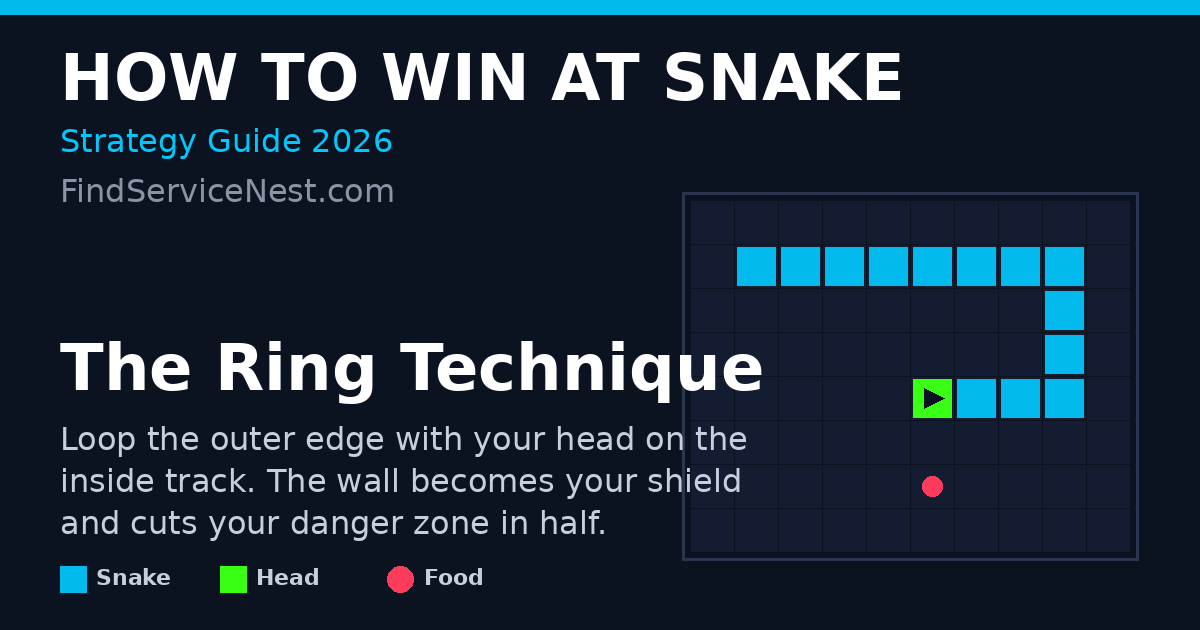
The ring technique — also called the perimeter or coil strategy — is the single most reliable way to survive a long snake. Here’s how it works:
- When your snake is getting long (roughly one-third of the board’s area), start moving in a large loop around the outer edge of the play area.
- Keep your head on the inside track of the loop so your body trails safely behind you along the wall.
- Eat food that appears inside the ring by making small inward turns, then return to the loop.
Why does it work? The wall becomes your shield: one entire side of your path can never contain your tail. This halves your danger zone and lets you focus only on the inside of the loop. The trade-off is that it eats up space — use it when you’re long, not when you’re short.
What Are the Biggest Mistakes That Kill Long Runs?
- Chasing food through your own body. The food will respawn somewhere else. Never thread your head through a gap narrower than your snake is wide. Patience saves more runs than speed.
- Trapping yourself in a corner. Corners reduce your escape options to one direction. If food spawns in a corner, plan your exit before entering.
- Panic-turning after eating. Right after eating, your body grows at the tail — your head area actually gets safer, not more dangerous. Keep your plan instead of jerking the head.
- Playing too fast on speed-up versions. Many browser versions accelerate as you eat. At higher speeds, switch from reactive play to the ring technique immediately — your reaction time can’t keep up forever.
How Do You Play When the Board Gets Crowded?
Late game is about space management, not food:
- Shrink your territory deliberately. Coil into a tight spiral in one corner, leaving the opposite side open. Eat only food that spawns in your open half.
- Think in “free squares.” Before each turn, notice how many empty squares surround your head. If that number is shrinking over several moves, you’re being herded toward a trap — widen out now.
- The tail is your friend. In classic Snake, the tail moves forward one square every tick. A square your tail just left is safe. Use the tail’s wake as an escape corridor.
Does Practice Really Improve Your Score?
Yes — and faster than you’d expect. Snake rewards pattern recognition: after a few dozen runs, you’ll start seeing trap shapes before they form. The best training loop is short:
- Play 5 runs focusing on one skill (e.g., “no corner deaths”).
- Watch where you died and name the mistake out loud.
- Apply it next run.
Players who do this consistently report doubling their average scores within a week. For more casual strategy reading, our Wordle strategy guide and Sudoku strategy guide apply the same pattern-first thinking to other classic games.
FAQ
How do you get a high score in the snake game?
Eat food in a consistent pattern, use the ring technique once your snake gets long, avoid corners, and never chase food through your own body. The highest scores come from survival, not from eating fast.
What is the best strategy for snake game?
The perimeter (ring) technique is the most reliable: loop your snake around the board’s outer edge with your head on the inside track. It uses the wall as a shield and cuts your danger zone in half.
Who invented the Snake game on Nokia?
Taneli Armanto, a Nokia design engineer, programmed Snake for the Nokia 6110 in 1997. The concept itself traces back to the 1976 arcade game Blockade.
Why is snake game so addictive?
One-mistake-per-run design, 1–10 minute sessions, and instant restarts create a frictionless loop. Every crash feels fixable, so players immediately try again — a pattern that has kept the game popular for nearly three decades.
Sources
- It’s Nice That — “The history of Snake: How the Nokia game defined a new era for the mobile industry” (Taneli Armanto interview): https://www.itsnicethat.com/features/taneli-armanto-the-history-of-snake-design-legacies-230221/
- TalkAndroid — “A Look At How Classic Mobile Title Snake Has Moved From Nokia to Browser Accessibility”: https://www.talkandroid.com/518821-snake-games-from-classic-nokia-to-browsers/
Leave a Reply