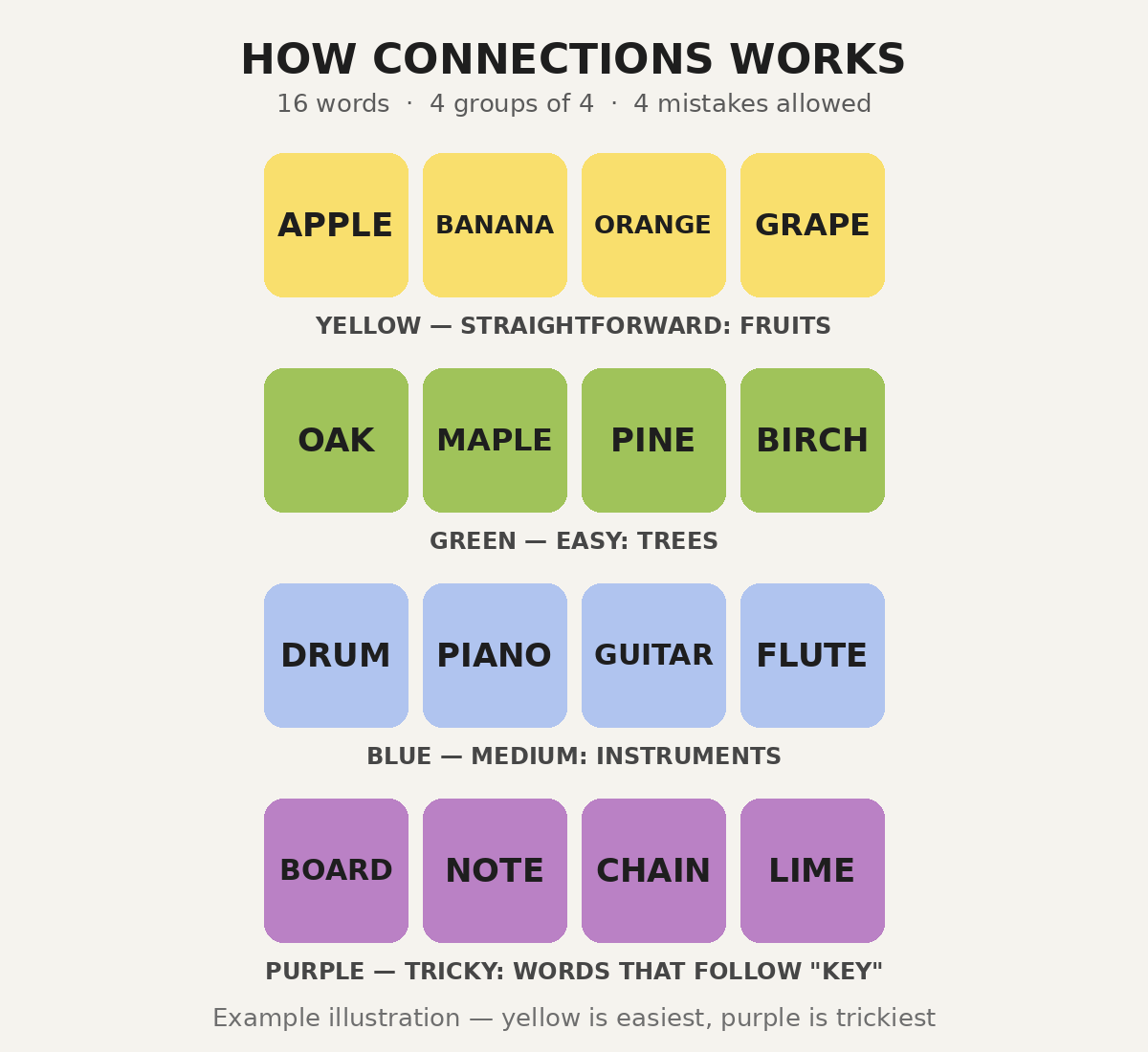
NYT Connections is a free daily word puzzle from The New York Times: you sort 16 words into 4 groups of 4, with only 4 mistakes allowed. The best strategy is to scan the whole grid first, solve the easiest group first, watch out for words with double meanings, and use the shuffle button when you get stuck.
How Does NYT Connections Work?
Every day, Connections gives you a 4×4 grid of 16 words. Your job is to divide them into four groups of four, where each group shares one hidden connection. Tap four words you think belong together and press Submit.
Get a group right and the four words lock in, get color-coded, and the category name is revealed. Get it wrong and you lose one of your 4 mistakes — tracked as dots at the bottom of the screen. Use up all four and the game ends, revealing every answer. A new puzzle drops every day and is only available for 24 hours, so there is exactly one puzzle per day for everyone.
What Do the Colors Mean in NYT Connections?
Each solved group is assigned a color that tells you how tricky the connection was:
- Yellow — Straightforward. The easiest group. Simple, common-knowledge categories like “types of fruit” or “parts of a car.”
- Green — Easy. Still direct, but needs a little more thought, such as “sailors’ knots.”
- Blue — Medium. More abstract connections requiring a small leap in logic, like “palindromes.”
- Purple — Tricky. The hardest group by design. Usually built on puns, wordplay, or a connection that has nothing to do with the words’ meanings — for example, words that all start with the name of an animal.
You do not have to solve them in order. In fact, cracking the purple group first sometimes unlocks the whole grid, because its words are so specific that they stop distracting you from the easier groups.
What Are the Best Strategies to Win NYT Connections?
- Read all 16 words before touching anything. Spend 30 seconds scanning the full grid first. Look for overlaps, puns, and words with multiple meanings. Players who rush to submit the first obvious-looking group are the ones who burn through their four mistakes fastest.
- Solve the easiest group first. Start with the group you feel most confident about — usually the yellow-level category. Each solved group removes four words and the remaining tiles shuffle, which makes the leftover words far easier to read.
- Hunt the red herrings. The puzzle makers deliberately include words that fit two plausible categories. If you spot five words that could all be fruits, at least one of them is a trap — it belongs to a different group. Flag these overlaps early and stay suspicious of them.
- Think beyond the word’s meaning. Blue and purple categories are rarely about definitions. They are about how words are structured or used: words that complete the same phrase (“___-raising”: back, hair, splitting, tie), homophones, or words sharing a hidden pattern. If the obvious meaning is not working, ask what else the word could be.
- Use the “One away!” message wisely. When a wrong guess earns a “One away!” message, it means 3 of your 4 words are correct. The trap is to randomly swap one word and guess again. Instead, stop and rethink the entire category definition — the three correct words may be connected in a more specific way than you first assumed, which tells you exactly what the fourth word should be.
- Hit shuffle when you are stuck. The shuffle button rearranges the grid, and that alone can break a mental block. The game’s editor has noted the original word order is arranged to mislead you, so reshuffling can place two related words side by side and spark the connection you were missing.
- Check verbs and adjectives, not just nouns. Most players gravitate toward nouns. But some of the sneakiest categories are built on verbs (“ways to throw something”) or adjectives. When the nouns refuse to cooperate, shift your focus to the other parts of speech on the grid.
- Say the words out loud. Homophone and rhyming categories hide in plain sight when you only read silently. Reading the grid aloud can reveal sound-based connections — words that rhyme or sound identical — that your eyes skip over.
- Play every day. Pattern recognition is a skill, and it compounds. Daily players start recognizing the puzzle makers’ favorite tricks: the fill-in-the-blank purple, the five-words-for-four-slots red herring, the category that is really about spelling. Reviewing a tough puzzle’s answers after you fail is one of the fastest ways to improve.
If you enjoy daily word challenges, our Wordle strategy guide and Sudoku strategy guide use the same kind of systematic thinking.
What Mistakes Should You Avoid in Connections?
The biggest mistake is overthinking: the simplest connection is often the right one, especially for the yellow group. The second biggest is ignoring alternate meanings — a word like “saw” can be a tool, a movie, or part of a saying, and the puzzle is counting on you to pick the wrong one. Finally, do not waste guesses early. With only four mistakes allowed, every submission should be a considered one, not a hopeful tap.
Frequently Asked Questions
How often does NYT Connections reset? A new Connections puzzle is released every day and each puzzle is available for only 24 hours before it is replaced.
Is NYT Connections free to play? Yes. Connections is currently free for everyone on The New York Times Games website and in the NYT Games mobile app.
What does “One away!” mean in Connections? It means three of the four words you submitted form a correct group, but one word is wrong. Use it as a clue to identify the intruder and find the true fourth word — do not just guess randomly.
Where can I play NYT Connections? On The New York Times Games website or through the NYT Games mobile app, where the daily puzzle resets every 24 hours.
Leave a Reply