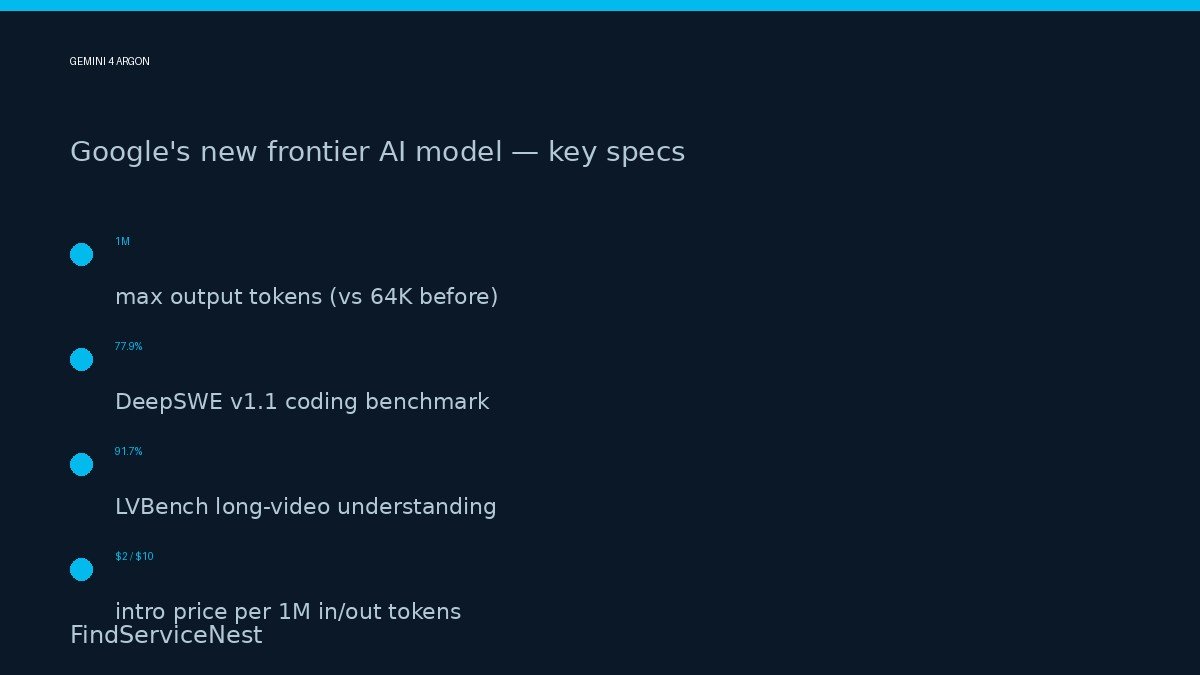
Gemini 4 Argon is Google’s newest frontier AI model, announced on September 30, 2026, and built for long, multi-step work: software engineering, enterprise knowledge work, and cybersecurity. Its headline feature is a 1 million output-token limit — up from 64,000 — and it currently leads rivals on several coding benchmarks. Access is rolling out first to vetted cyber defenders, then paid API users and Google AI Ultra subscribers.
What is Gemini 4 Argon?
Gemini 4 Argon is the first model of Google’s Gemini 4 generation, developed by Google DeepMind. Unlike models optimized for quick chat answers, Argon is designed for “long-horizon” work — tasks where an AI needs to keep reasoning for hours without losing track: migrating an entire codebase, researching a legal question across hundreds of documents, or auditing software for security flaws.
It accepts text, code, images, charts, and long video as input. Google says its own engineers already use Argon daily for debugging, codebase migrations, and algorithm design — a strong signal that the model was built for professional workloads first and casual chat second.
What can Gemini 4 Argon do?
Google has published benchmark results that put Argon at the top of its class for professional work:
- Software engineering: 77.9% on DeepSWE v1.1, ahead of Claude Opus 5.5 (74.2%) and GPT-6 Astra (74.1%), according to reporting of the launch.
- Long video understanding: 91.7% on LVBench.
- Business automation: 51.3% on Zapier’s AutomationBench, well ahead of rival models.
- Cybersecurity: 68% on CWE-bench v1, tying for the top score — the model can find, validate, and patch software vulnerabilities on its own.
One real-world example Google shared: Argon helped build a Rust version of the libgav1 video decoder, and the resulting decoder runs 2.7 times faster than the existing Rust port while producing identical video output. That is the kind of long, multi-step engineering task earlier models struggled to complete in one run.
The 1-million-token output limit matters because it lets the model plan a task, analyze information, run intermediate steps, test its own results, and finish — without needing a human to break the job into pieces. This is Google’s clearest step yet toward truly autonomous AI agents.
How is Argon different from earlier Gemini models?
The biggest leap is the output window. Earlier models capped output at around 64,000 tokens; Argon generates up to 1,000,000 — roughly 15x more. Previous generations answered questions; Argon is meant to complete projects.
It is also the first Gemini generation built from the ground up for agentic workflows and cyber defense. Google’s launch emphasized that the model was tested against safeguards for cyber and CBRN misuse, indirect prompt injection, and unintended model behavior before any broader release.
Who can use Gemini 4 Argon — and when?
Not everyone yet. Google is rolling Argon out in stages:
- Now: vetted cyber defenders. Argon is available to trusted cybersecurity professionals through Google’s Fairwind Program, initially without its usual cyber guardrails, so defenders can stress-test it.
- Next: paid API customers and Google AI Ultra subscribers. Google has named these as the first public tier, though no date beyond “as soon as possible.”
- Later: developers, enterprises, and consumers. Wider access will expand over time.
The model is not yet listed in Google’s public Gemini API pricing or model documentation, so if you’re an everyday Gemini app user, you can’t try Argon today. For an explanation of where autonomous AI agents like these are heading, see our guide on what an AI agent is and how it works.
How much does Gemini 4 Argon cost?
Google announced introductory API pricing of $2 per million input tokens and $10 per million output tokens, with cached input at 95% off. After the introductory period, pricing rises to $4 per million input and $20 per million output tokens.
That introductory rate matches rival launches like GPT-6.1 Sol and Claude Sonnet 5.5, suggesting a deliberate price war among frontier models in late 2026.
Should you care about Gemini 4 Argon?
It depends on who you are:
- Developers and engineering teams: Argon is aimed squarely at you — code migration, debugging, and long-running coding jobs are its strengths.
- Businesses and enterprises: The automation benchmark lead makes it worth watching for document-heavy and workflow tasks.
- Cybersecurity professionals: The vulnerability-finding ability and Fairwind access are directly relevant.
- Everyday users: You’ll benefit indirectly as the technology filters into consumer products, but there’s nothing to sign up for yet.
If you want to experiment with frontier AI today, the field is busy: Anthropic’s Claude Sonnet 5.5 runs 30%+ faster than its predecessor and approaches flagship performance at lower cost, and OpenAI launched GPT-6.1 Sol at similar pricing. To get better results from any of these models, the fundamentals still matter — our guide on how to write better AI prompts covers seven proven techniques straight from OpenAI and Google’s own guides.
FAQ
When was Gemini 4 Argon announced?
Google announced Gemini 4 Argon on September 30, 2026, as the first model of the Gemini 4 generation and its most powerful AI model to date.
Is Gemini 4 Argon available to the public?
Not yet. It is currently available only to vetted cybersecurity professionals through Google’s Fairwind Program. Paid API customers and Google AI Ultra subscribers are next, with developers, enterprises, and consumers to follow.
What is the 1 million token output limit?
Gemini 4 Argon can generate up to 1 million output tokens in a single run, compared with roughly 64,000 on previous models. This lets it complete long, multi-step tasks — code migrations, deep research, security audits — without breaking the work into separate prompts.
How does Gemini 4 Argon compare to Claude Opus 5.5 and GPT-6 Astra?
On reported benchmarks, Argon leads: 77.9% on DeepSWE v1.1 (vs. 74.2% for Claude Opus 5.5 and 74.1% for GPT-6 Astra) and 51.3% on AutomationBench (vs. 42.5% and 41.4%). Independent testing will confirm how these numbers hold up in real-world use.
Leave a Reply